
The American frontier has produced countless legends. Outlaws became folk heroes, and lawmen became myths. Yet among all the stories born from the Wild West, few are as unsettling as the tale of Alferd Packer.
More than 150 years after five men disappeared in Colorado’s San Juan Mountains, historians are still debating what happened during the winter of 1874. At the center of the mystery stands Packer, the lone survivor who emerged from the wilderness carrying the belongings of his companions and offering a series of explanations that seemed to change every time he told them.
Was he a desperate man forced into unimaginable choices by starvation? Or was he a heartless murderer?
The truth remains buried somewhere beneath snow, speculation, and one of the strangest criminal cases in American history. To understand the Alferd Packer case, it is important to understand the world in which it occurred.
Gold Fever and the American Frontier
The 1870s were a period of westward expansion and opportunity. Mining camps appeared almost overnight throughout Colorado Territory as rumors of gold spread across the country. Thousands of prospectors arrived, hoping to strike it rich. They often ventured into some of the most dangerous landscapes in North America. The San Juan Mountains, however, were among the most unforgiving.
Severe winter storms, deep snow, and limited resources made travel extraordinarily difficult. Even experienced mountain men understood the dangers of crossing the region during winter. According to historical accounts, Ute Chief Ouray warned travelers against attempting the journey, knowing how quickly the mountains could turn deadly.
For many prospectors, however, the promise of fortune outweighed caution. Among them was Alferd Packer.
The Expedition Into the San Juans
Born in Pennsylvania in 1842, Packer lived a largely unsettled life before arriving in Colorado. He briefly served during the Civil War before drifting westward in search of work and opportunity. By 1874, he had become one of countless men hoping to build a future in the booming mining regions of the Rocky Mountains.
In January 1874, Packer joined a small group of prospectors attempting to cross the San Juan Mountains.
The party consisted of Israel Swan, Frank Miller, George Noon, James Humphrey, Shannon Bell, and Packer himself. Their goal was simple: reach the mining districts beyond the mountains and get some gold. What should have been a difficult journey soon became a desperate fight for survival. Food supplies dwindled as winter conditions worsened. Snow buried trails and slowed travel to a crawl. Temperatures dropped. The men became increasingly isolated from civilization and any chance of assistance.
Weeks passed without word from the group.
Then months.
By spring, many assumed the mountains had claimed yet another party of fortune seekers. Then, unexpectedly, one of them returned.
The Man Who Walked Out Alone
On April 16, 1874, Alferd Packer arrived at the Los Pinos Indian Agency. The appearance of a lone survivor immediately raised concerns. Five men were missing and only Packer had returned.
Even more troubling were the circumstances surrounding Packer’s survival. Witnesses reported that he carried money and possessions that belonged to members of the missing party. Some observers also questioned whether he appeared too healthy for someone who had supposedly endured months of starvation in the wilderness.
Of course, questions were asked.
“Where were the others?”
“What had happened in the mountains?”
And how exactly had Packer survived when everyone else had died?
His answers were definitely not consistent. Initially, Packer claimed the men had become separated during the journey. Later, his story changed. He admitted that the group had perished and that he had survived by consuming human flesh.
The confession was shocking, but it would only be the beginning.
Confessions, Contradictions, and Cannibalism
As investigators pressed for answers, Packer’s account continued to evolve. In one version of events, starvation and exposure claimed the lives of the other men. According to this explanation, he resorted to cannibalism only after death had already taken its toll. Another version painted a much darker picture. Packer claimed that Shannon Bell had gone mad from hunger, murdered the other members of the party, and eventually attacked him as well. Packer said he killed Bell in self-defense and survived by eating the bodies only when all other options had disappeared.
The problem was that none of the stories aligned perfectly. Each of the confessions Packer made introduced new contradictions, and his explanations raised additional questions. Investigators soon realized they were dealing with the only surviving witness to the tragedy and a witness whose credibility was rapidly collapsing. When search parties eventually located the remains of the missing prospectors, the findings horrified the public. The bodies showed clear signs of butchering. Flesh had been removed from bones, and human remains were scattered around the campsite. There was little doubt that cannibalism had occurred.
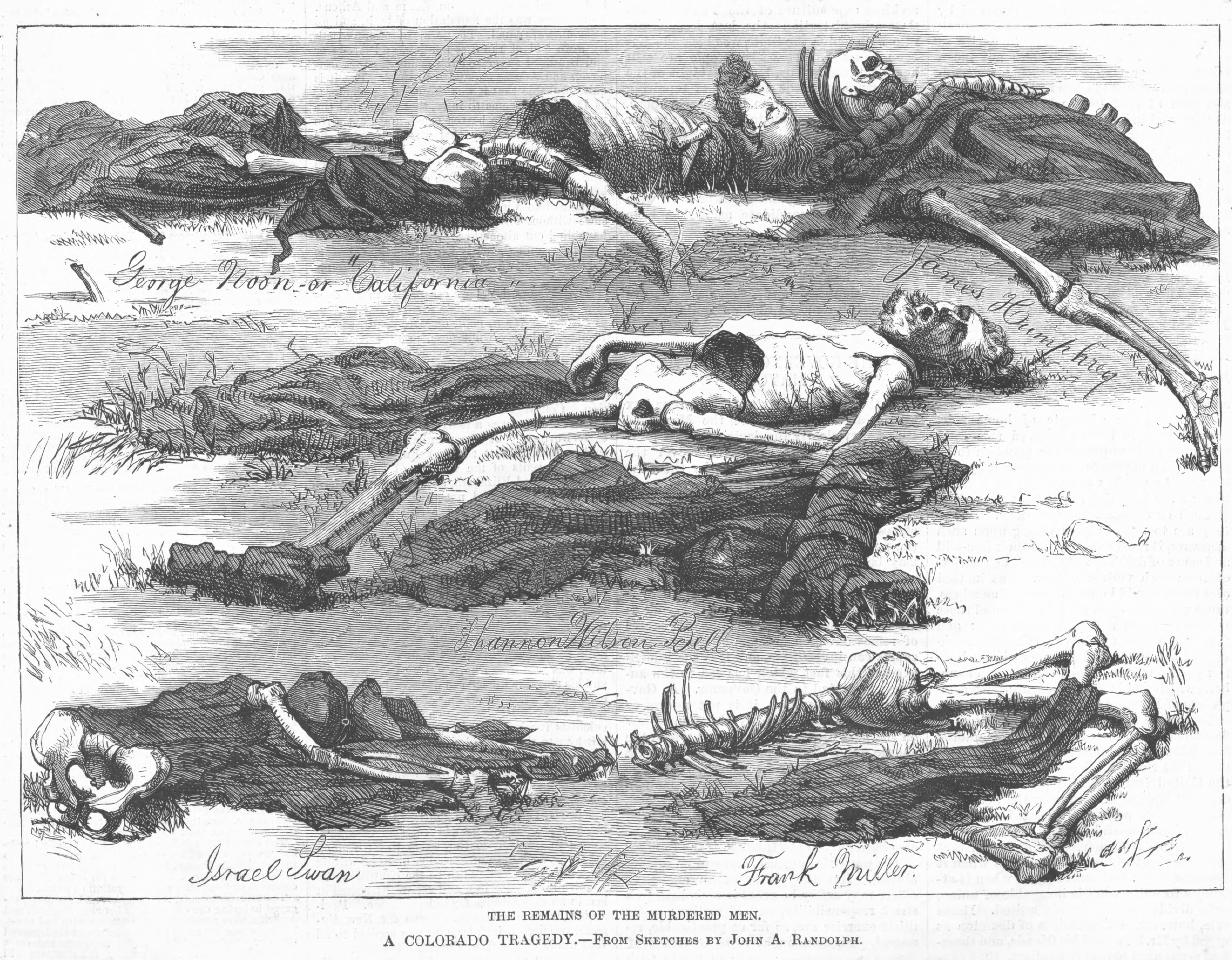
Whether the men had died naturally or been murdered remained far less certain. For the newspapers, however, uncertainty was less important than spectacle. The story spread rapidly across the country, transforming a regional criminal investigation into a national sensation.
How Newspapers Turned Packer Into a Legend
The late nineteenth century was an era when newspapers competed aggressively for readers. Sensational crimes sold papers, and the Packer case contained every ingredient necessary for a media phenomenon. There was Murder, Cannibalism, A remote mountain wilderness, and a mysterious lone survivor. Journalists focused heavily on the grisliest aspects of the story. Headlines emphasized horror and violence while often overlooking the complicated details surrounding the investigation.
As the story spread, Packer’s image became larger than life. He was no longer simply a suspect, but became “The Colorado Cannibal.” The nickname captured the public imagination and ensured that his story would survive long after the legal proceedings ended. Newspapers transformed Packer from a man into a myth.
The Trial of the Colorado Cannibal
The legal battle that followed only added to the legend. Packer fled Colorado before eventually being captured years later. His case moved through multiple trials, appeals, convictions, and reversals. At one point, he was sentenced to death. Judge Melville Gerry famously condemned him during sentencing, portraying him as a man who had deliberately led his companions into the wilderness only to rob and murder them.
Yet even after the verdicts were delivered, uncertainty remained. The evidence was incomplete. The witness testimony was limited, and the only person who truly knew what happened in the mountains was still changing his story.
What Modern Forensics Revealed
More than a century later, the mystery received renewed attention when researchers revisited the site during the 1980s.
Using modern archaeological and forensic techniques, investigators examined the remains and evidence left behind.
Their findings confirmed that the bodies had been butchered and used as a food source.
However, some discoveries complicated the traditional narrative.
Several skull injuries appeared inconsistent with portions of Packer’s confessions. Questions emerged about the timing of certain injuries and the sequence of deaths. Some researchers argued that the evidence did not entirely support either the prosecution’s theory or Packer’s own explanations. Rather than solving the mystery, forensic science reopened it. The mountains, it seemed, were still keeping some of their secrets.
Colorado’s Most Uncomfortable Folk Legend
Today, Colorado maintains a surprisingly complicated relationship with Packer. Museums preserve artifacts connected to the case. Historians continue to debate his guilt. Tourists visit locations associated with the story. At the same time, Packer has become an unlikely part of Colorado folklore. Perhaps the most famous example was the Alferd Packer Memorial Grill at the University of Colorado Boulder, which embraced dark humor with the slogan, “Have a friend for lunch.”

The joke reflected something unusual about Packer’s legacy. Colorado has never fully embraced him, but it has never entirely let him go either.
From History to Pop Culture
As the decades passed, Packer’s story found new life in books, documentaries, television specials, and films.
The strangest adaptation arrived in 1993 when future South Park creators Trey Parker and Matt Stone released Cannibal! The Musical. The low-budget comedy transformed one of Colorado’s most disturbing historical events into an absurd musical filled with songs, satire, and dark humor. What had once horrified nineteenth-century audiences became entertainment. Yet even after countless retellings, adaptations, and investigations, the central mystery remained unresolved.
The Mystery That Refuses to Die
Perhaps that uncertainty explains why the Alferd Packer story continues to fascinate people more than a century later.
Cannibalism alone does not make the case unique. History contains numerous examples of survival cannibalism under extreme circumstances. What sets Packer apart is the lack of answers. Five men entered the mountains. One man survived. And the only witness left behind was multiple versions of the same story.
For historians, the case remains one of the American West’s most intriguing mysteries. Yet For Colorado, it remains a piece of folklore that refuses to fade.
